Restoring native sea-run fish populations to historic spawning and nursery habitat in one of MDI’s largest watersheds.
The watershed comprises over 1,000 surface acres of lake and stream habitat.
Alewives, a type of river herring, are anadromous fish that spend most of their lives at sea and migrate to freshwater lakes and ponds to reproduce. Blueback herring are the other river herring species and they have a preference for spawning in rivers and streams. Bluebacks are less common in Maine than alewives and are very rare in our run in Somesville. For more on Maine’s sea-run fish species, including the river herring, click here.

Early New Englanders relied on alewives as an important food source. In a lesson learned from Native Americans, the corn that the Pilgrims ate at the first Thanksgiving was fertilized with alewives. It is believed that of all the migratory fish that came up Maine’s rivers, alewives were the most abundant. Those numbers dropped significantly in the 1980s and 1990s due to overfishing, pollution of river waters, and the presence of dams without functional, or perhaps any, fish ladders for passage upstream and back. Long-time Somes Brook streamside resident Marie Nolf, who lived to be 100 years old, shared stories of wading in the brook in Somesville with alewives filling all of the water from bank to bank, and having them bump into her legs on their way upstream. The Somesville run on Mt. Desert Island (MDI) was harvested for several years in the 1970s and early 1980s by Dennis Smith who had the contract to do so from the Town of Mt. Desert. Alewives were and still are an important lobster trap bait, prized by those who fish for the famous crustacean. Currently there are about 25 runs with sustained high numbers that are harvested. Harvest was halted in our watershed as numbers declined.
In 2005 former Director of the Sanctuary, David Lamon, recognized the difference between the old-timers’ stories of plenty and what he was seeing. That year he counted only 361 alewives entering the Mill Pond, for the entire migration!

In the Mill Pond watershed in Somesville, Maine, several dams were constructed by the late 1700’s to support saw, grist and woolen mills, important structures for the areas’ economic growth at the time. With the establishment of these dams subsequent runs diminished to negligible numbers. (Runs did not entirely disappear, because some fish were caught below and released above the dams by citizens interested in preserving an alewife run.) Fishways (also known as fish ladders) were eventually installed in these dams allowing alewives to continue in their natural migration, but in recent times those fishways had fallen into serious disrepair and alewife runs nearly disappeared.
As a result of the startling low count, David and the Sanctuary brought together a diverse group of partners to support the restoration of diadromous fish species in the Long Pond-Somes Pond watershed of MDI. The goal was to restore native sea-run fish populations including alewife, American eel, and sea lamprey to historic spawning and nursery habitat in one of MDI’s largest watersheds, with about 1,000 surface acres of lake and stream habitat.
Through the combined efforts of a diverse coalition of agencies, organizations, and residents the following tasks have been accomplished: repairs and modifications to four deteriorated fishways; installation of educational exhibit at the historic Mill Pond site; data collection of alewife populations during spring spawning runs; population enhancements via stocking of alewife from other source areas in cooperation with the Maine Department of Marine Resources; education programs for local and distant schools plus a variety of other visiting groups; and the development of a corps of volunteers who help collect data and maintain open stream and fish ladder passageways.

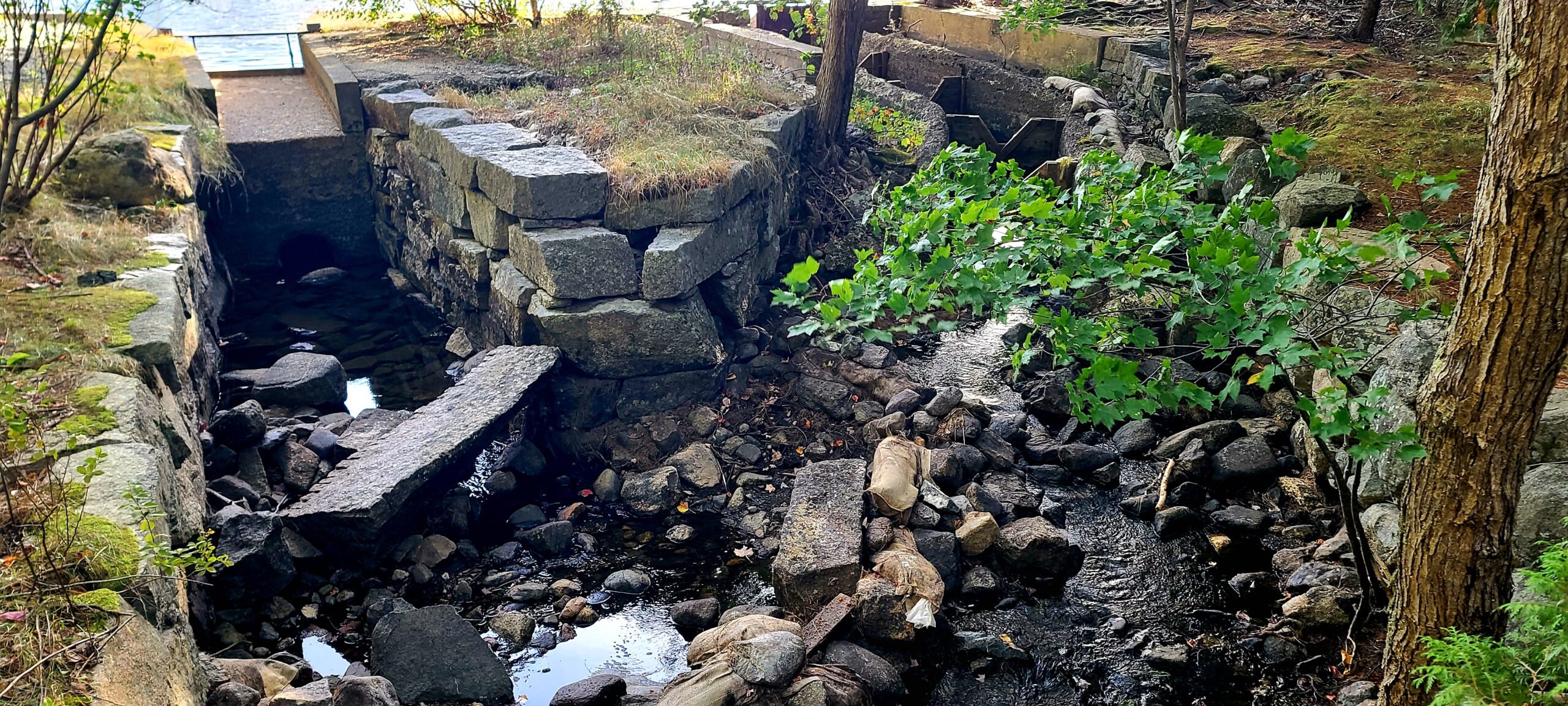
The flow of water in our stream and lake system varies greatly, as it does elsewhere, from very high flooding flows in the spring to later summer and fall trickles during our not uncommon drought years. Getting adult fish in to spawn is often easier than getting adults, and particularly juveniles back out, and requires constant vigilance and action to keep fish from getting stranded.
For more on how the Somesville alewife run has recovered, with a lot of ups and downs along the way go to the Somesville Alewife Migration Study page.